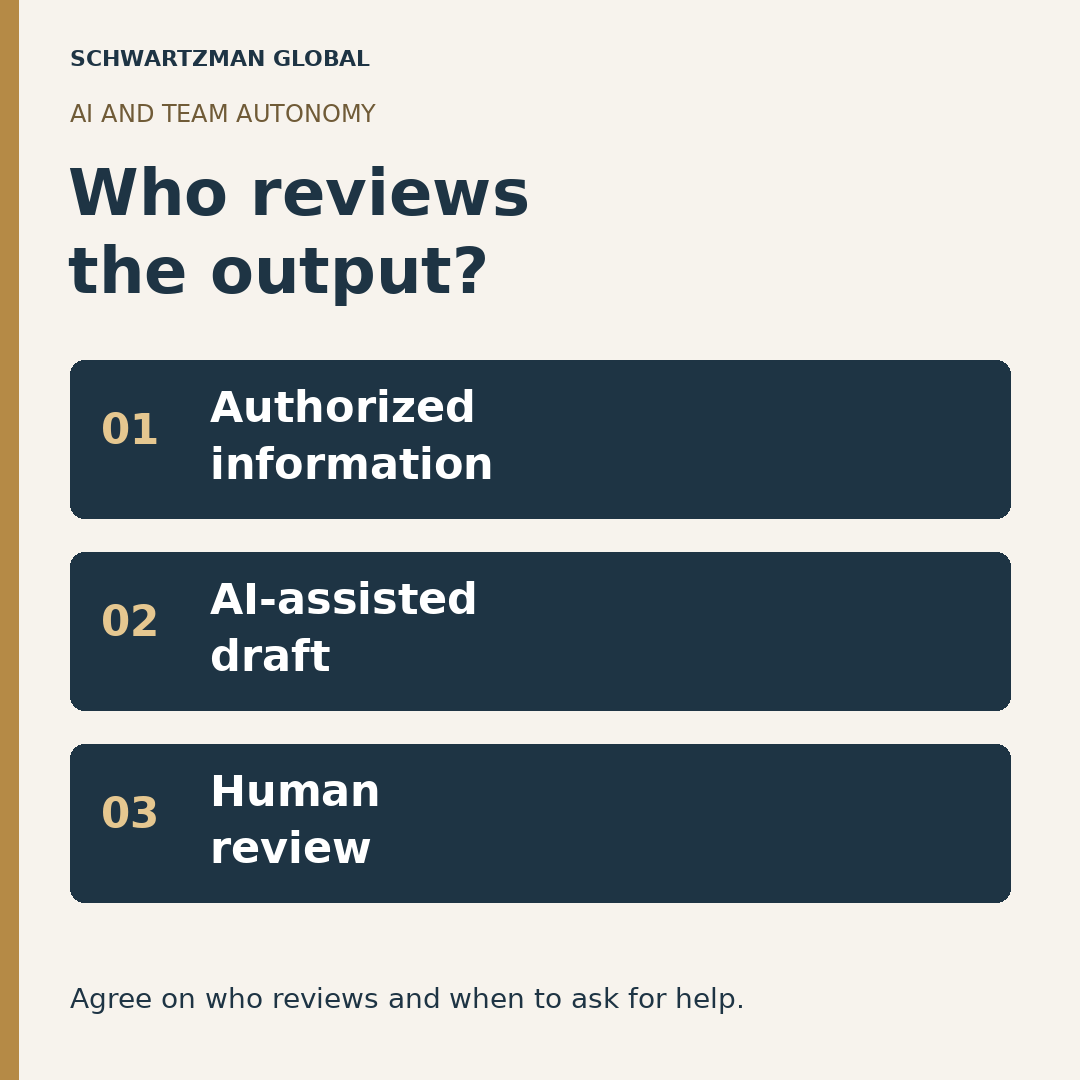
Your team starts using AI to prepare summaries, instructions and reports. Drafts arrive faster, but every one lands in your inbox with the same request: “Can you review this?”
If you are preparing the business to operate with less of your day-to-day involvement, look closely at that review step. What does the team need to check before it can deliver acceptable work without you correcting every version?
Start with one low-risk internal task. The approach in this article is a micro-experiment: a small trial with a responsible person, defined resources and a date to review what you learned.
1. Choose a task someone on the team can verify
Look for work whose output can be checked against a known source. For example, turn an activity list into a draft weekly summary for internal use. Someone familiar with those activities should be able to verify what was completed, what is still pending and what information is missing.
Use fictional data for the first trial. Before introducing real information, confirm which tool is approved, what data it may receive and who may access the output. Keep personal data, confidential information and sensitive decisions outside the trial unless the necessary permissions and controls are in place.
Generative AI can produce false information that sounds confident. The NIST Generative AI Profile describes this problem. Even a clearly written draft therefore needs to be checked against its source.
2. Agree on what makes the output acceptable
“Make sure it looks good” leaves too much open to interpretation. Write criteria the reviewer can apply. For the weekly summary, they could include:
- Every activity and its status match the source list.
- Dates and responsible people are preserved as recorded.
- Missing information is marked as awaiting confirmation.
- The draft adds no commitments, explanations or conclusions that are absent from the source.
Keep the source version used and the necessary corrections alongside the draft. This gives the review a concrete point of comparison.
3. Name the reviewer and define when to ask for help
Choose someone who understands the work, can consult the sources and has time to review it. Agree on what they may correct and approve within their current responsibilities. If they need preparation, review an example together before expanding their authority.
A fictional working agreement:
“You will prepare the draft summary. The operations lead will check each point against the original list and may correct writing and transcription errors. She may approve it only for the agreed internal use.
If information is missing, two versions conflict or a new commitment appears, you will leave that point pending and consult the person authorized to resolve it. The tool will not send messages or change records. This trial does not authorize spending or changes to client commitments.”
Specify who can help when the reviewer is unavailable. If there is no trained backup yet, keep the agreed review in place while preparing a second person. Avoid creating a new dependency on someone whose account or authorized information is unavailable to everyone else.
4. Measure the whole task, including review
On the agreed date, look at the time spent preparing, checking and correcting the output. Also record errors found, unresolved questions and the occasions when your involvement was needed, including the reason.
Compare that full sequence with the previous way of doing the same task, using examples of similar scope. Timing only the generation of a draft leaves out an important part of the work.
Ask together: could the reviewer detect and correct the errors? Did they have the information and authority they needed? Did the output meet the criteria? What would have happened if the tool had been unavailable?
If the trial requires more corrections than expected, narrow the task or keep the previous procedure while making adjustments. If it works in the cases reviewed, agree on the next trial and retain the necessary controls. A few correct examples do not establish that the process is reliable in every situation.
One practical step for this week
Choose a draft that currently lands in your inbox. Write down what must be checked, who has the ability and authority to check it, and which situations will still need your involvement.
Preparing to hand over leadership means helping other people sustain the work with judgment, information and support. This micro-experiment lets you observe one part of that preparation. It does not establish that the business is ready to operate without its owner or be sold.
Which task could you test with your team without making the entire review depend on you?
Prepare for your next stage as an owner
If you want to develop the people who will take on more responsibility in your family business, buy Handing Over Leadership on Kindle, by Arie Schwartzman.
For the person preparing to lead, the companion book is Stepping Up, also on Kindle. Both books are in English.
You can also explore the free English companion resources and audio recordings. They are public, require no book purchase and are not full audiobooks.
Read the notice about the books and their resources. Amazon displays the current purchase terms.
Reference and scope: NIST AI 600-1 (2024), section 2.2, supports only the observation about false information presented with apparent confidence. This article’s sequence, criteria and example are our own editorial proposal. The reference does not imply NIST endorsement or establish legal requirements for your business.
Educational content on business preparation and responsible use of tools. Keep applicable controls in place and use only authorized information. Sensitive or regulated processes require their own protocols and specialists. This is not legal, tax, financial or investment advice, or an offer of brokerage services.