Imagine your team has a guide for preparing its weekly meeting. A month ago, the team changed where it checks outstanding tasks and the cutoff time for updates. The guide still describes the old steps.
A new team member follows it and arrives with incomplete information. Someone else knows how the task works now, but nobody had agreed on who should update the document.
This is a hypothetical example. It raises a useful question when preparing a business for continuity: who makes sure the instructions still match the work?
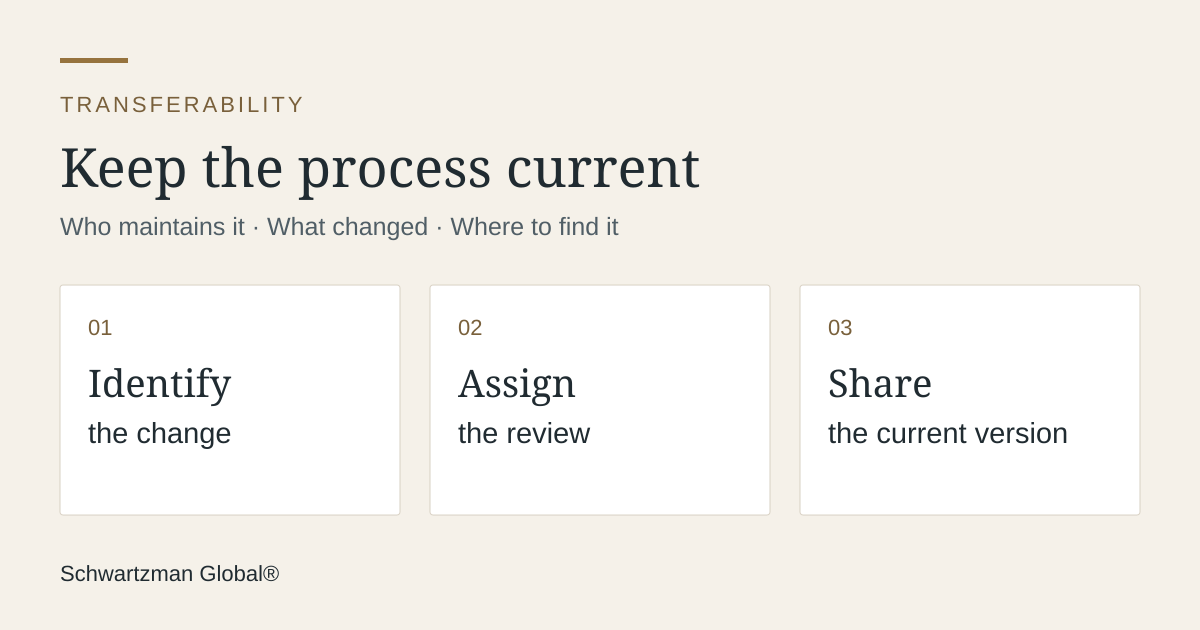
1. Assign someone to keep the process current
For a recurring task, agree on who receives questions, proposes revisions and checks that the guide reflects the authorized way of working. That person needs to understand the task and have time to review changes.
Also clarify who reviews or approves each type of revision. Fixing an incorrect link may need different treatment from changing another team's deadline. Maintaining a document does not authorize someone to change commitments, controls or responsibilities.
Agree on who handles questions when the responsible person is away. Maintaining the process should also be able to continue without depending on one individual.
2. Agree on which changes trigger a review
Ask people to flag changes that affect how the task is done, rather than waiting for errors to accumulate:
- The information used or the authorized place where it is found.
- A step, a tool or the order of work.
- The person receiving or reviewing the output.
- A deadline, an acceptance condition or a required approval.
The person who notices a difference can describe it in one specific sentence: “The guide says to use list A; the team has been using list B since Monday.” The person responsible then confirms which list is appropriate and what needs correcting.
A difference between the guide and actual practice may also reflect an execution error. Review it before turning it into a new instruction.
3. Test the revision before calling it finished
In the meeting example, the responsible person verifies where the information should be found and confirms the agreed cutoff time with the team. They update those two points and ask someone else to prepare a practice draft using the guide.
They can use fictional data for this test. They check whether it is clear where to look, which updates to include and what to do when information is missing. If a new question comes up, they resolve it before announcing the current version.
Keep this exercise to a routine, low-risk task. Processes involving payments, sensitive data, safety or regulatory requirements need the appropriate controls, permissions and specialist support.
4. Make it clear which version the team should use
Keep the current guide in an authorized location the team already uses. Include the review date, the responsible person and a brief note explaining what changed. Follow the company's rules for identifying and retaining earlier versions.
Tell the people who do the task and those who receive their work. Sharing the link helps; explaining the specific change tells them what to do differently.
Sample internal update, using fictional details:
“The weekly meeting guide now reflects the approved changes: check outstanding tasks in the Operations workspace and use Thursday at 4 p.m. as the information cutoff.
The current version is in the team's process folder, with an October 7 review date. Ana handles questions, and Luis covers for her when she is away.
If you find conflicting information, flag it before replacing it. Deadline changes still require agreement from the people involved.”
5. Check whether every revision still needs the owner
At the next review, ask what changed, who confirmed it and which questions remain open. Look at whether the team maintained the guide within its authority or had to turn to you because an agreement was missing.
If every correction reaches the business owner, review which decisions the responsible people can make and which still need to be referred to someone else. The goal is for the team to maintain the work within clear limits.
This provides useful information when preparing a handover: who understands the process, who maintains it and what still depends on you. Current documents alone do not establish that the whole business is ready for a transfer.
Start with a guide people already use
Choose a frequent, low-risk process. Ask the people doing it which instruction no longer matches their work. Agree on who will review it, who needs to approve the revision and when you will check that the corrected version is clear.
Who will keep that guide current after this first review?
Reference: the EPA's Guidance for Preparing Standard Operating Procedures (2007, sections 2.2 and 2.3; PDF) recommends reviewing and approving procedures, updating them when they change and recording their revisions. It is a quality-management reference. The example and sequence in this article are our own editorial proposal for routine tasks; they do not imply EPA endorsement or establish legal requirements for your company.
Educational content about business preparation and operational continuity. Use authorized information and preserve your organization's controls. This is not financial, investment, tax or legal advice, or an offer of brokerage services.